
City Edition
Middlesex County
Melrose, Massachusetts
In November 2025, Melrose voters were handed a ballot with three price tags on it: $9.3 million, $11.9 million, or $13.5 million in new property taxes. They approved all three, so the largest one took effect. The Boston Globe reported that no Massachusetts community had approved a bigger override in at least 35 years. More than 11,000 people voted, about 52 percent of everyone registered, and a city that had spent years cutting services started writing a budget that restores them. That is what local government looks like when residents actually show up. This guide shows you how Melrose works: the mayor who proposes the budget, the eleven councilors who vote on it, the committee that runs your schools, the legislators who carry your voice to Boston and Washington, and the numbers underneath all of it.

The Melrose Civics Handbook
A plain-language guide to how your city works: who represents you, how decisions get made, and how to make your voice heard. Read it online.
Melrose at a Glance
Sources: Massachusetts DESE, district profile · US Census Bureau (data.census.gov) · City of Melrose.
- County: Middlesex. Melrose packs its residents into about 4.7 square miles just north of Boston, with the Middlesex Fells Reservation along its western edge.
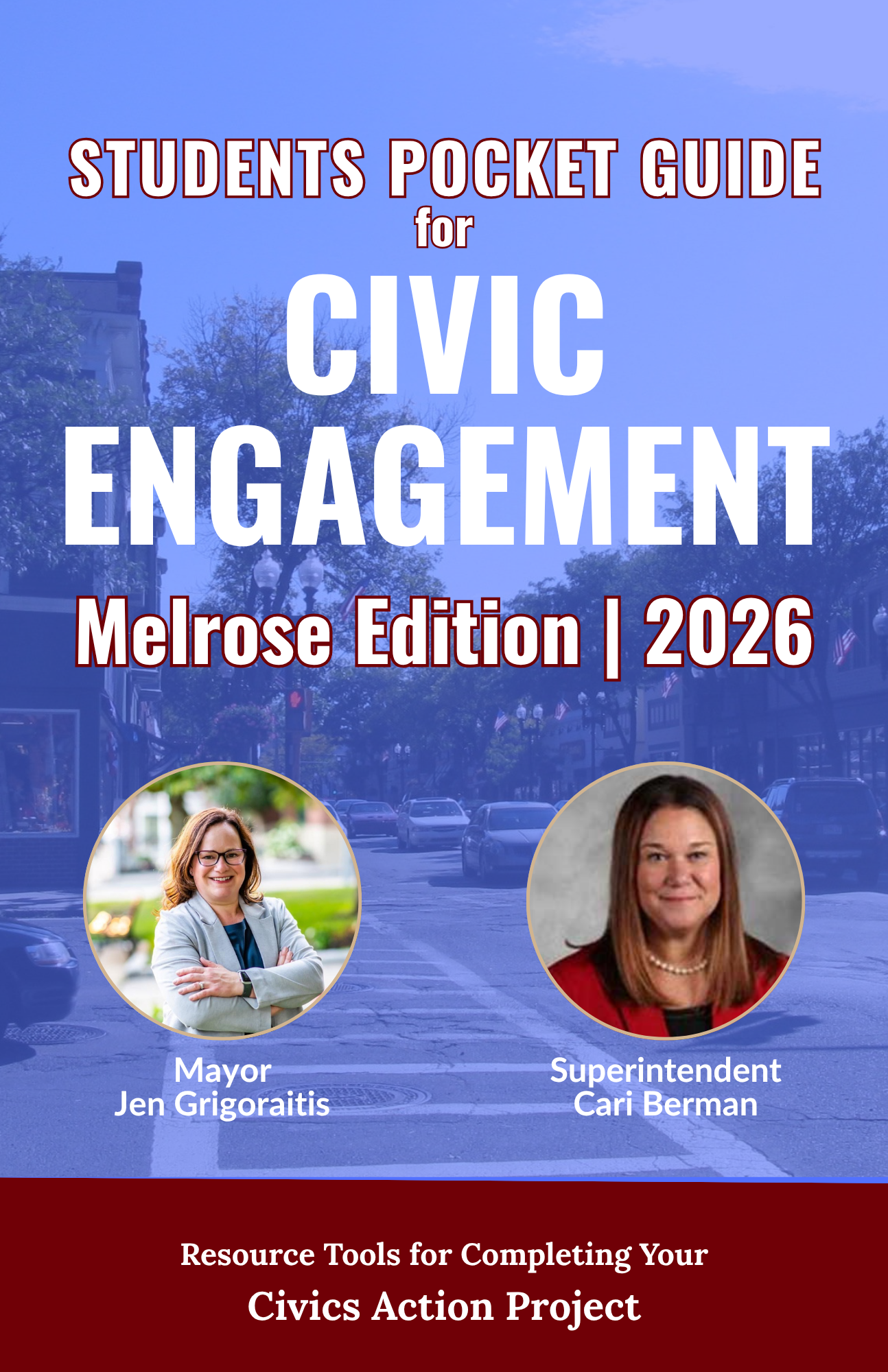
- Government: Strong-mayor charter. Mayor Jen Grigoraitis, the first woman elected mayor of Melrose, took office in January 2024.
- Schools: Melrose Public Schools, about 3,700 students across eight schools, led by Superintendent Cari Berman.
How Melrose’s Government Works
Melrose runs on a strong-mayor charter. Voters elect a Mayor to run the city, an eleven-member City Council to make its laws and vote its budget, and a School Committee to oversee the schools. The Mayor holds real executive power: appointing department heads, proposing the budget, and running every city department. The Council is the check. It can cut what the Mayor proposes, and no police chief or fire chief takes office until the Council confirms the appointment.
The Mayor
The elected chief executive, serving a four-year term. Runs every department, appoints department heads subject to Council confirmation, proposes the budget, and sits on the School Committee.
City Council
The eleven-member legislative body. Four councilors are elected at large and seven by ward, all to two-year terms. The Council votes the budget, passes ordinances, and confirms appointments.
School Committee
Seven seats: six elected citywide, plus the Mayor, who holds the seventh by virtue of the office. It hires the Superintendent and approves the school budget.
- Residents elect the Mayor, the eleven councilors, and the six elected School Committee members.
- The Mayor proposes the budget and runs the city day to day.
- The Council votes the budget up or down, can cut it, and confirms the Mayor’s major appointments.
- Voters decide the biggest questions directly. A Proposition 2 1/2 override, like the one Melrose passed in 2025, can only be approved at the ballot box.
Explore the Melrose Edition
- Mayor’s OfficeThe chief executive and what the job actually controls
- City CouncilAll eleven members, how to reach them, when they meet
- School CommitteeThe seven seats and the Superintendent
- City DepartmentsWho to call when something breaks
- Boards & CommissionsWhere volunteers decide real questions
- LegislatorsYour delegation on Beacon Hill and in Washington
- DemographicsWho lives in Melrose, by the numbers
- Melrose HistoryFrom North Malden to a city of 29,817
- Non-ProfitsThe organizations holding the city together
- Student DataEnrollment, graduation, and spending
Your County Officials
Two of the people with the most direct power over your life are elected, and neither one sits on Beacon Hill. The district attorney decides who gets charged with a crime, and what they get charged with. The sheriff runs the county jail. The sheriff is elected by the voters of Middlesex County. The district attorney is elected by the voters of a prosecution district, and Massachusetts draws eleven of those across its fourteen counties, so a district attorney’s territory does not always follow a county line. Both appear on your ballot in Melrose. Now you know what to look for.
 District Attorney, Northern District (Middlesex County)
Marian T. Ryan
Official site

Massachusetts elects fourteen sheriffs, one for each county, and eleven district attorneys, one for each prosecution district. The job is the same everywhere: the charging decisions, the jail. Look up any town in the state and see who holds these two offices there.
Your First Civic Action in Melrose
You do not have to wait until you can vote to be heard. Here is a concrete path from a problem on your street to the people who can fix it.
- Pick the right body. Anything about a school, a course, a bus, or a teacher goes to the School Committee. Everything else, from a broken sidewalk to the tax rate, goes to the City Council.
- Find the meeting. The City Council meets on the first and third Monday of most months at 7:45 p.m. in the Council Chamber on the first floor of City Hall, 562 Main Street. School Committee agendas are posted on the district website.
- Know your councilors. Four are elected at large by every Melrose voter, and seven represent a single ward. You get to contact all eleven, not just your own.
- Speak. Melrose allows public participation at Council meetings in person or remotely. Check the posted agenda for how to sign up.
- Or skip the trip. Report a pothole, a dead streetlight, or a missed pickup online through Melrose SeeClickFix at seeclickfix.com/melrose.
- City Hall: 562 Main Street, Melrose, MA 02176. Main line 781-979-4500.
- City Council and agendas: 781-979-4116, or email citycouncil@cityofmelrose.org.
- Melrose Public Schools: 781-662-2000, melroseschools.com.
Knowing who represents you is the first step. Learn how to write to them so it actually lands.
Sources
This guide draws on public sources, refreshed July 2026: U.S. Census Bureau, Massachusetts DESE School and District Profiles, Massachusetts Legislature (malegislature.gov), and the official Melrose government website.