
City Edition
Worcester County
Fitchburg, Massachusetts
The falls of the Nashua River once turned the machinery that made Fitchburg the “Paper City,” a 19th-century manufacturing powerhouse. The mills are mostly quiet now, but the machinery of the city itself still runs every day, and you can reach the people who operate it. This guide shows you who runs Fitchburg, how a budget and an ordinance actually get made, the boards where residents claim a seat, the legislators who carry your voice to Boston and Washington, and the numbers that tell the story of a diverse, reinventing city anchored by Fitchburg State University and a growing arts scene.

The Fitchburg Civics Handbook
Everything in this guide, gathered into one plain-language handbook: how your city works, who represents you, how the decisions that shape your street actually get made, and where you can push on them. Read it online.
Fitchburg at a Glance
Sources: Massachusetts DESE, district profile · US Census Bureau (data.census.gov) · City of Fitchburg.
- County: Worcester. Fitchburg is the county’s third-largest city, sitting on the Nashua River about 50 miles northwest of Boston.
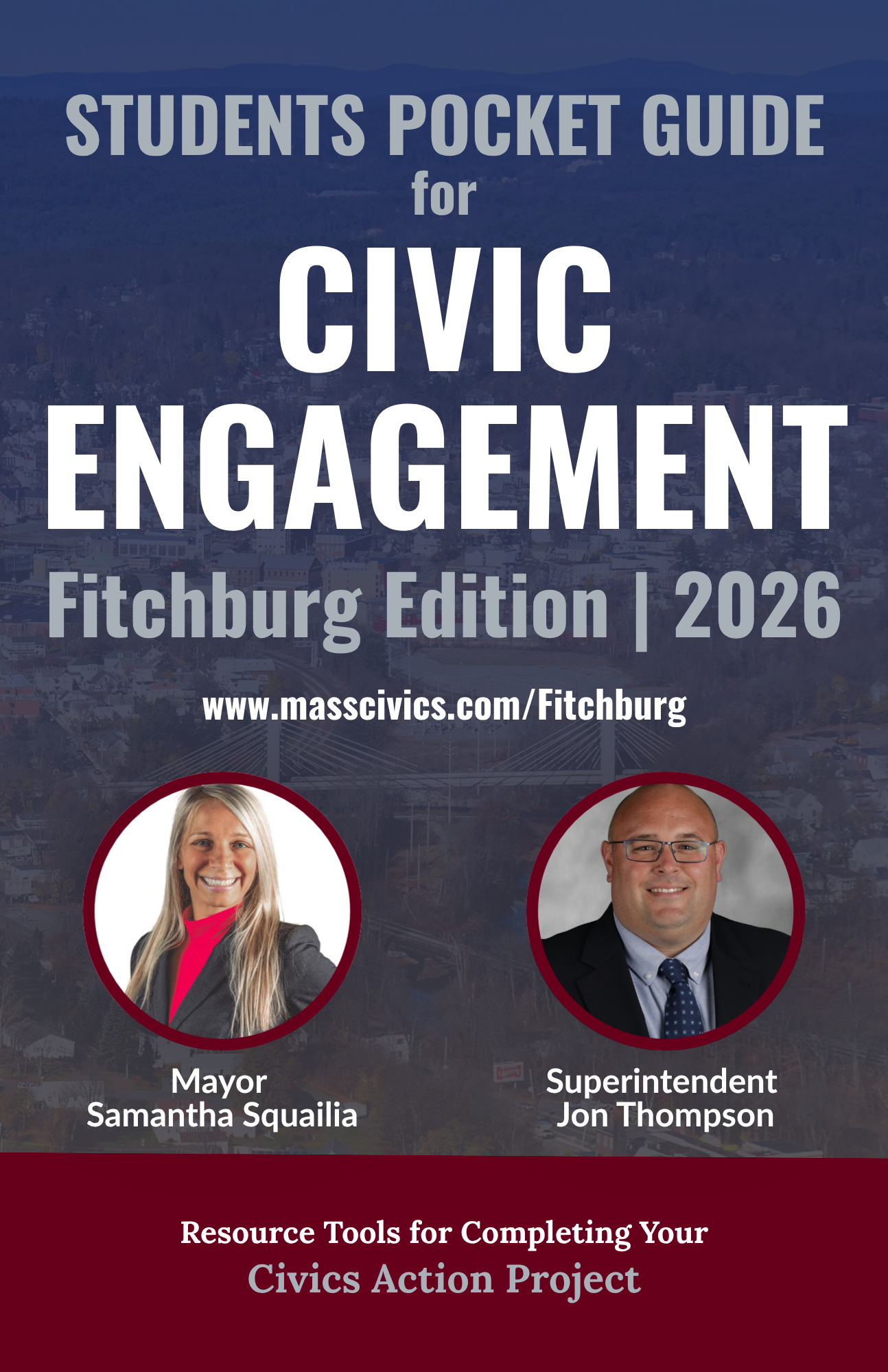
- Government: a strong-mayor system. Mayor Samantha “Sam” Squailia, in office since January 2024 and re-elected in November 2025, is the full-time chief executive, and an eleven-member City Council writes the city’s laws.
- Schools: Fitchburg Public Schools enrolls about 5,300 students across eight schools, led by Superintendent Jon Thompson.
How Fitchburg’s Government Works
Fitchburg runs on a “strong mayor” design, and the word strong is doing real work. In some Massachusetts cities an unelected manager handles the day-to-day. Fitchburg has no manager. The Mayor you elect runs the departments, writes the budget, and appoints the people who fill the potholes and hire the teachers, while the eleven-member City Council passes the laws and decides whether to approve that budget. Two elected powers, one checking the other, and both answerable to you.
Mayor
Your elected chief executive. Directs every city department, writes the annual budget, appoints officials, and carries out the law.
City Council
Eleven members, five elected city-wide and six tied to your ward. They pass ordinances, set policy, and hold the final vote on the budget.
School Committee
The Mayor chairs it. It sets school policy, adopts the school budget, and hires the Superintendent who runs your schools.
- Residents elect the Mayor, the eleven councilors, and the School Committee every two years.
- The Mayor administers the city day to day and proposes the budget that funds it.
- The Council legislates, turning proposals into ordinances and approving or cutting the budget.
- You take part. Speaking at public forum, applying for a board seat, or calling your ward councilor all change what happens next, whether or not you can vote yet.
Explore the Fitchburg Edition
- Mayor’s OfficeThe city’s chief executive
- City CouncilYour eleven councilors
- School CommitteeSuperintendent & committee
- City DepartmentsWho does what at City Hall
- Boards & CommissionsWhere residents serve
- LegislatorsYour voice in Boston & D.C.
- Fitchburg HistoryFrom paper city to today
- DemographicsWho lives in Fitchburg
- Non-ProfitsCommunity organizations
- Student DataFitchburg Public Schools by the numbers
Civic Calendar
- City Council: meets the first and third Tuesday of each month at 7:00 PM in the Legislative Building, 700 Main Street.
- School Committee: meets at least monthly, with sessions broadcast on Fitchburg Access Television (FATV).
- Municipal elections: held in odd-numbered years, with the Mayor, Council, and School Committee all on the ballot. The next one is in November 2027.
- State and federal elections: held in even-numbered years. The 2026 primary and general fall this year.
Your County Officials
Two of the people with the most direct power over your life are elected, and neither one sits on Beacon Hill. The district attorney decides who gets charged with a crime, and what they get charged with. The sheriff runs the county jail. The sheriff is elected by the voters of Worcester County. The district attorney is elected by the voters of a prosecution district, and Massachusetts draws eleven of those across its fourteen counties, so a district attorney’s territory does not always follow a county line. Both appear on your ballot in Fitchburg. Now you know what to look for.

Massachusetts elects fourteen sheriffs, one for each county, and eleven district attorneys, one for each prosecution district. The job is the same everywhere: the charging decisions, the jail. Look up any town in the state and see who holds these two offices there.
Your First Civic Action in Fitchburg
You do not have to wait until you can vote to be heard in this city. Here is a concrete path from the couch to the council floor.
- Find who answers for your street. Fitchburg has six wards, each with its own councilor, plus five at-large councilors elected by the whole city. Look up your ward on the city’s website, then reach your councilor through the City Council office at City Hall, 718 Main Street, 978-829-1800.
- Show up to a meeting. The Council meets the first and third Tuesday of each month at 7:00 PM in the Legislative Building at 700 Main Street, and every meeting opens with a public forum right after the Pledge of Allegiance. Stand, give your name and city, and you have up to two minutes on any item on that night’s agenda.
- Use the school lever. The School Committee, chaired by the Mayor, controls the budget and policy for your schools and meets at least monthly. Its public-comment period is the most direct say a student has over their own education. A Student Advisory Committee also brings high-schoolers into the conversation.
- Take a seat. Many of Fitchburg’s boards and commissions have open seats and no age floor for some advisory roles. Apply through the Mayor’s Office at City Hall.
Local government works best when residents show up. Find the councilor who answers for your ward, speak at a meeting, or apply for a seat on a board.
Sources
This guide draws on public sources, refreshed July 2026: U.S. Census Bureau, Massachusetts DESE School and District Profiles, Massachusetts Legislature (malegislature.gov), and the official Fitchburg government website.