
City Edition
Suffolk County
Chelsea, Massachusetts
Everything you need to understand and take part in local government in Chelsea: who runs the city, how decisions get made, and how you can have a say, paired with the Chelsea edition of the civics handbook.

The Chelsea Civics Handbook
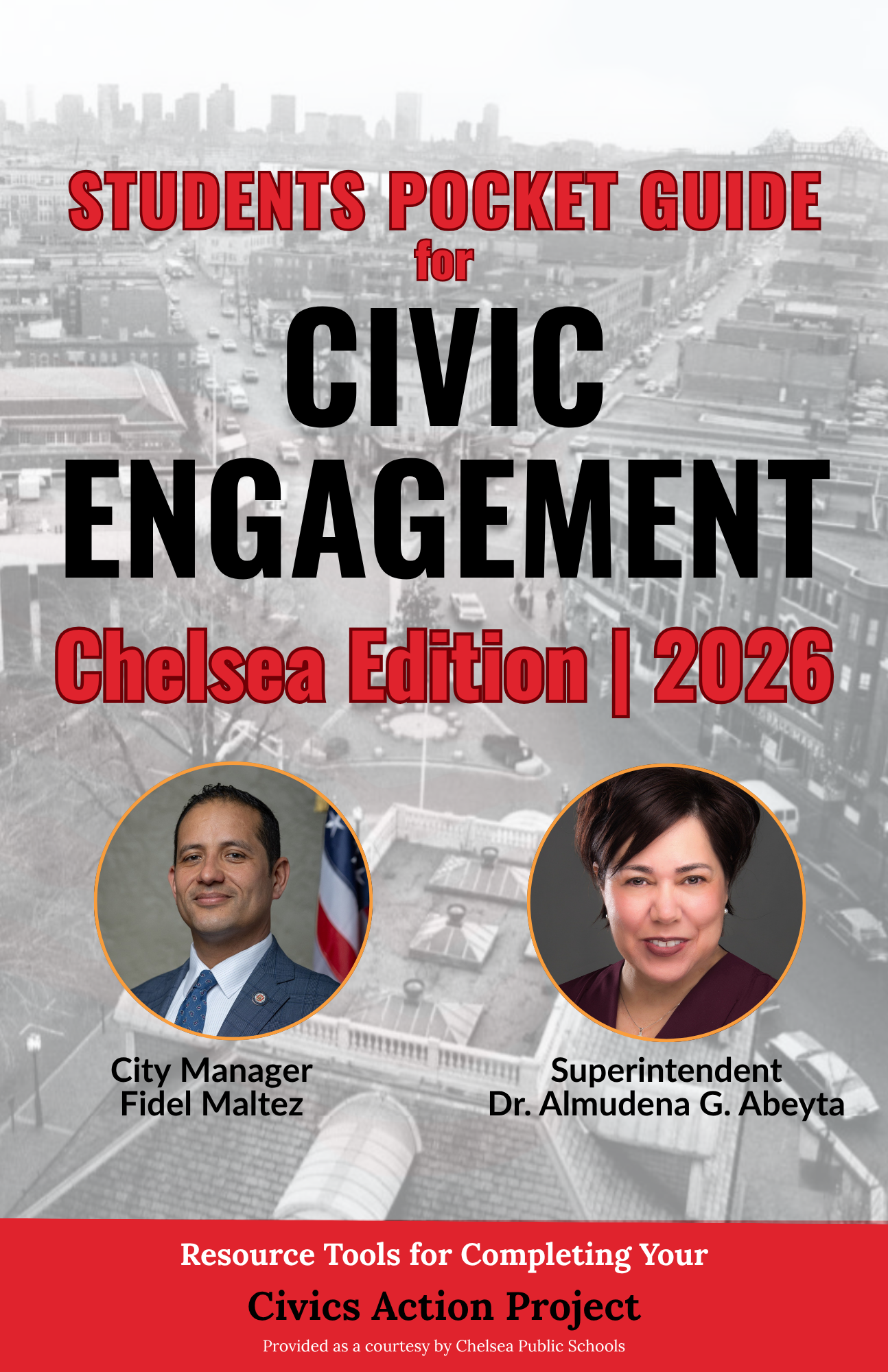
The Chelsea edition of the Massachusetts Students Pocket Guide to Civic Engagement: fully online and tailored to your community. Find your district councilor, explore city departments, and understand how local decisions get made.
Chelsea at a Glance
Sources: Secretary of the Commonwealth, voter enrollment · US Census Bureau (data.census.gov).
- County: Suffolk County, smallest city in Massachusetts, directly across the Mystic River from Boston
- Government: Council-Manager (1994 charter), City Manager Fidel Maltez since January 2024
- Schools: Chelsea Public Schools, ~5,749 students across 11 schools
How Chelsea’s Government Works
City Manager
Chelsea’s chief executive, appointed by the City Council. Manages all departments, prepares the budget, and delivers city services.
City Council
11 members: 3 at-large, 8 district, serving two-year terms. Adopts ordinances, approves the budget, and appoints the City Manager.
School Committee
Sets policy for Chelsea Public Schools and hires Superintendent Dr. Almi Abeyta. Nine elected members: one at-large and one per district.
How a resident takes part
- Attend a meeting. The City Council meets two Mondays per month (Sept to June) in Council Chambers (City Hall, 3rd floor, 500 Broadway) and is broadcast on Chelsea Community Cable (Comcast Ch. 22).
- Speak up. Council and School Committee meetings include public comment. Submit written comments by noon on the Wednesday before each Council meeting at chelseama.gov.
- Contact your district councilor. Each of Chelsea’s eight districts has its own elected councilor, the person closest to issues on your street.
- Vote in city elections. Municipal offices are on the ballot every odd-numbered year. Register through the Chelsea City Clerk at chelseama.gov.
Explore the Chelsea Edition
- City Manager’s OfficeFidel Maltez and the city’s administrative team, what the office does and how to reach it.
- City CouncilChelsea’s 11-member legislative body and your district councilors.
- School Committee & SuperintendentThe elected School Committee and Dr. Almi Abeyta’s office.
- City DepartmentsContacts and responsibilities for every city department.
- Boards & CommissionsThe appointed bodies that guide planning, licensing, and local policy.
- LegislatorsThe state senator and representative who represent Chelsea at the State House.
- Chelsea HistoryFrom Winnisimmet and colonial settlement to the Great Fires, state receivership, and immigrant renewal.
- DemographicsPopulation, race, income, housing, and voter registration data for Chelsea.
- Non-Profits & Food ResourcesKey community organizations and food resources serving Chelsea residents.
- Schools & Student DataStudent demographics, MCAS scores, graduation rates, and district enrollment.
Civic Calendar
- City Council: 2nd & 4th Monday, September to June · City Hall Room 306; in recess July and August.
- School Committee: Evenings during the school year, check chelseaschools.com for exact dates.
- Next city election: November 2027, City Council and School Committee (two-year terms).
- Speak at a meeting: Contact the City Clerk, Chelsea City Hall, 500 Broadway, for public comment rules.
Your County Officials
Two of the people with the most direct power over your life are elected countywide. The district attorney decides who gets charged with a crime, and what they get charged with. The sheriff runs the county jail. Both of them answer to the voters of Suffolk County, and that includes Chelsea. They appear on your ballot. Now you know what to look for.


Every county in Massachusetts elects its own, and the job is the same everywhere: the charging decisions, the jail. Look up any town in the state and see who holds these two offices there.
Your First Civic Action in Chelsea
You do not have to wait until you can vote to be heard. Chelsea is the smallest city in Massachusetts, which means the people who run it are unusually easy to reach. Here is a concrete path from “I care about this” to “I said it on the record to the people who decide,” using rooms and phone numbers that are already open to you.
- Pick the right body. A park, a road, a pothole, your taxes, or a line in the city budget is City Council territory. Your school, a class, a program, or the school calendar belongs to the School Committee.
- Find the meeting. The City Council meets two Mondays a month from September through June in the Council Chambers on the third floor of City Hall, Room 306, 500 Broadway, and is in recess in July and August. Meetings air on Chelsea Community Cable, Comcast Channel 22. The School Committee meets in the evening during the school year. You can submit written comments by noon on the Wednesday before each Council meeting at chelseama.gov.
- Know your councilors. Chelsea has eleven councilors: eight district councilors, one for your own district and closest to the issues on your street, plus three at-large. For agenda and public-comment rules, reach the City Clerk through City Hall at 617-466-4000.
- Speak. Both the City Council and the School Committee include public comment. You sign up, you get your minutes, and you say your piece on the record.
- Or skip the trip. Report a pothole, a broken streetlight, or a trash problem any time through Chelsea’s 311 system at chelseama.qscend.com/311, or call City Hall at 617-466-4000.
- City Hall (main line): 617-466-4000
- Chelsea Public Schools: 617-466-4477, chelseaschools.com
Sources
This guide draws on public sources, refreshed July 2026: U.S. Census Bureau, Massachusetts DESE School and District Profiles, Massachusetts Legislature (malegislature.gov), and the official Chelsea government website.