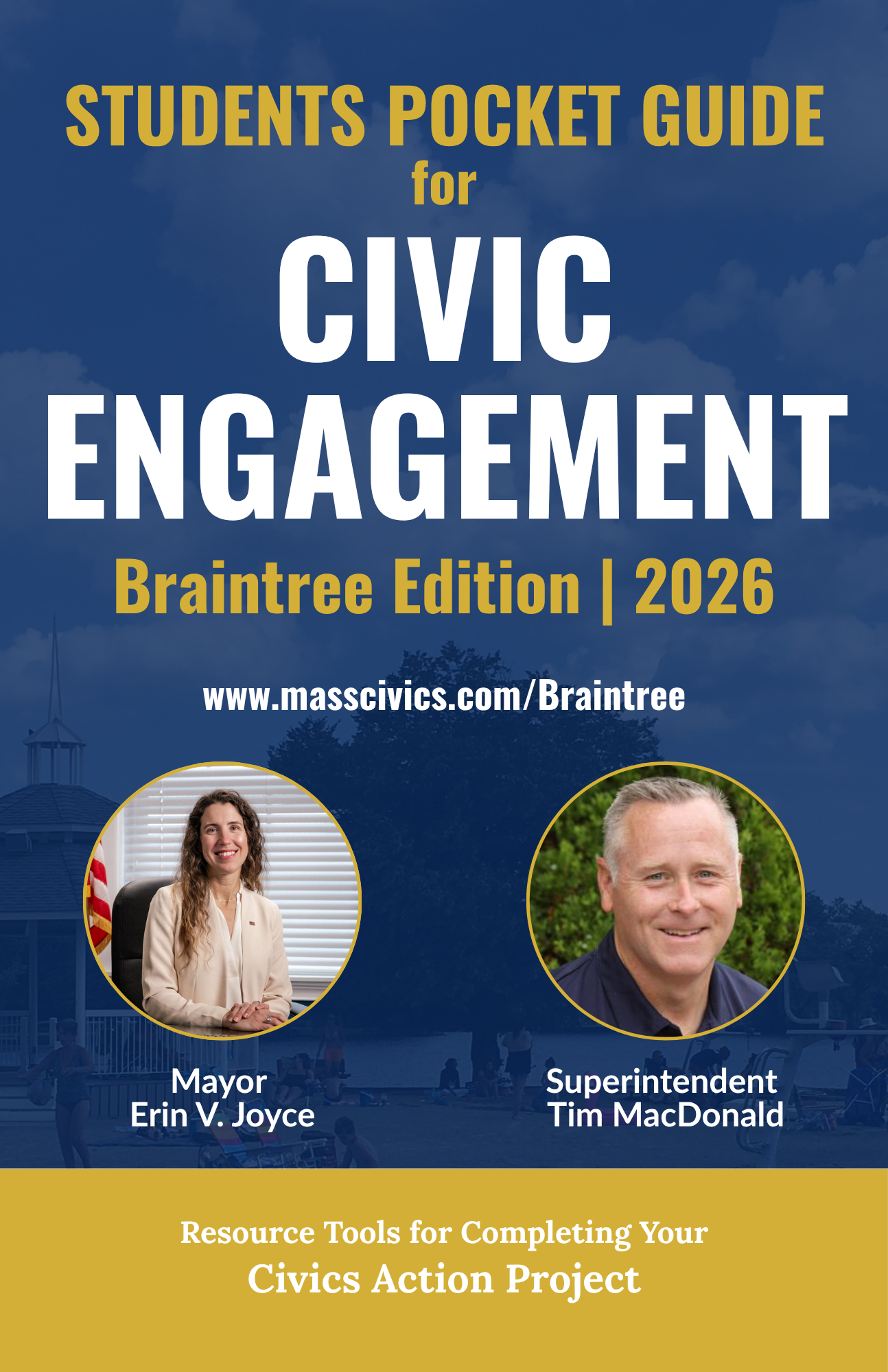

Town Edition
Norfolk County
Braintree, Massachusetts
Braintree is a town with a mayor, which sounds like a contradiction until you hear the story. In 2008 the people who live here did something dramatic: they scrapped the representative town meeting, heir to the town meetings that had governed Braintree since 1640, and handed real authority to a single elected executive, a mayor, checked by a nine-member Town Council. Today that town of about 39,000 people sits at the end of the Red Line, wrapped around South Shore Plaza, on land that once stretched far enough to include the birthplaces of two American presidents. This guide shows you how Braintree works now: the mayor who runs it, the nine councilors who make its laws, the legislators who carry your voice to Boston and Washington, and the data behind it all.

The Braintree Civics Handbook
A plain-language guide to how your town works: who represents you, how decisions get made, and how to make your voice heard. Read it online.
Braintree at a Glance
Sources: Massachusetts DESE, district profile · US Census Bureau (data.census.gov) · Town of Braintree.
- County: Norfolk. Braintree sits on the South Shore between Quincy and Weymouth, about ten miles south of Boston, with a Red Line terminus and Route 3 running through it.
- Government: a strong-mayor charter in effect since January 2008. Mayor Erin V. Joyce, the town’s first woman mayor, has led Braintree since January 2024.
- Schools: Braintree Public Schools, about 5,058 students across nine schools, led by Superintendent Tim MacDonald.
How Braintree’s Government Works
Braintree runs on a strong-mayor charter that took effect in January 2008, replacing the old representative town meeting. Voters elect a Mayor to run the town and a nine-member Town Council to make its laws, and they elect a School Committee to oversee the schools. The Mayor holds real executive power: appointing department heads, proposing the budget, and overseeing every town service.
The Mayor
The elected chief executive. Runs every department, appoints department heads and most board members, and builds the budget the Town Council votes on.
Town Council
The nine-member legislative body. Six councilors are elected by district and three at large. The Council passes ordinances, sets the tax rate, and adopts the budget.
School Committee
Six members elected by voters, plus the Mayor as an ex-officio member. It sets school policy, approves the school budget, and hires the Superintendent.
- Residents elect the Mayor, the nine councilors, and the School Committee.
- The Mayor runs the town day to day and proposes the budget.
- The Council votes the budget and the ordinances up or down.
- You take part: public comment, board service, and a call to your district councilor all shape what happens next.
Explore the Braintree Edition
- Mayor’s OfficeThe town’s chief executive
- Town CouncilYour nine councilors
- School CommitteeSuperintendent & committee
- Town DepartmentsWho does what at Town Hall
- Boards & CommissionsWhere residents serve
- LegislatorsYour voice in Boston & D.C.
- Braintree HistoryFrom a colonial parish to a Red Line town
- DemographicsWho lives in Braintree
- Non-ProfitsCommunity organizations
- Student DataBraintree Public Schools by the numbers
Civic Calendar
- Town Council: meets the first and third Tuesdays at 7:30 PM in the Horace T. Cahill Auditorium at Town Hall, 1 John F. Kennedy Memorial Drive.
- School Committee: meets at the Colbert Administration Building, 348 Pond Street, with agendas posted on the district website.
- Municipal elections: odd-numbered years. The Council was last chosen in November 2025. The Mayor next runs in 2027.
- State and federal elections: even-numbered years. The 2026 state election is on November 3.
Your County Officials
Two of the people with the most direct power over your life are elected, and neither one sits on Beacon Hill. The district attorney decides who gets charged with a crime, and what they get charged with. The sheriff runs the county jail. The sheriff is elected by the voters of Norfolk County. The district attorney is elected by the voters of a prosecution district, and Massachusetts draws eleven of those across its fourteen counties, so a district attorney’s territory does not always follow a county line. Both appear on your ballot in Braintree. Now you know what to look for.

Massachusetts elects fourteen sheriffs, one for each county, and eleven district attorneys, one for each prosecution district. The job is the same everywhere: the charging decisions, the jail. Look up any town in the state and see who holds these two offices there.
Your First Civic Action in Braintree
The fastest way to feel how the town works is to bring one real concern to the people who can fix it. Here is how to do it from scratch.
- Pick the right body. Streets, the budget, and ordinances go to the Town Council. Anything about the schools goes to the School Committee.
- Find the meeting. The Council meets the first and third Tuesdays at 7:30 PM in the Horace T. Cahill Auditorium at Town Hall, 1 John F. Kennedy Memorial Drive.
- Know your councilors. You have three at-large councilors who answer to the whole town, plus one councilor for your own district. Find your district on the town website.
- Speak. Residents can address the Council. Check the agenda on the town website for the public-comment procedure.
- Or skip the trip. Report a pothole, a dead streetlight, or a missed pickup any time through Braintree’s online SeeClickFix tool.
- Town Hall: 1 John F. Kennedy Memorial Drive, Braintree, MA 02184. Town Council office 781-794-8152.
- Agendas & minutes: posted on the town website, with the Town Clerk, Eric A. Cocca, at 781-794-8240.
- Public schools: Braintree Public Schools, 781-380-0130, braintreeschools.org.
Local government works best when residents show up. Find your district councilor, speak at a Tuesday meeting, or apply to serve on a board.
MassCivics last checked this page on September 25, 2026.
Sources
- Population and demographics: US Census Bureau, 2020 Census, P1, Braintree Town city, as of April 1, 2020.
- Schools and districts: Massachusetts DESE, district profile, Enrollment Data (2025-26), as of October 1, 2025.
- Schools and districts: Massachusetts DESE, district profile, general, as of October 1, 2025.
- Elections and voter enrollment: Secretary of the Commonwealth, Upcoming Elections, as of September 1, 2026.
- Town records: Town of Braintree, Mayor’s Office, as of January 28, 2026.
- Town records: Town of Braintree, Planning and Community Development, as of January 28, 2026.
- Town records: Town of Braintree, School Committee, as of January 28, 2026.
- Town records: Town of Braintree, Town Council, as of January 28, 2026.
- Town Clerk records: Town of Braintree, Town Clerk, as of September 3, 2026.
- Town Clerk records: Town of Braintree, Town Elected Officials 2026-2027, as of January 28, 2026.
- Charter and bylaws: Town of Braintree, Braintree Town Charter, as of January 2008.