
City Edition
Worcester County
Worcester, Massachusetts
In Worcester, the people who decide how your street gets plowed, whether your school gets repaired, and how your tax dollars get spent all work in buildings you can walk into and meetings you are allowed to attend. This guide shows you who they are, how the machinery actually moves, and where you can put your hands on it: the mayor and city manager who run daily life, the eleven councilors who write local law, the legislators who carry your voice to Boston and Washington, and the data that tells the story of the second-largest city in New England, the one people here call the “Heart of the Commonwealth.”

The Worcester Civics Handbook
A plain-language guide to how your city works, who represents you, how decisions get made, and how to make your voice heard. Read it online.
Worcester at a Glance
Sources: Massachusetts DESE, district profile · US Census Bureau (data.census.gov) · City of Worcester.
- County: Worcester, the county seat and the second-largest city in New England, about 40 miles west of Boston at the center of the state.
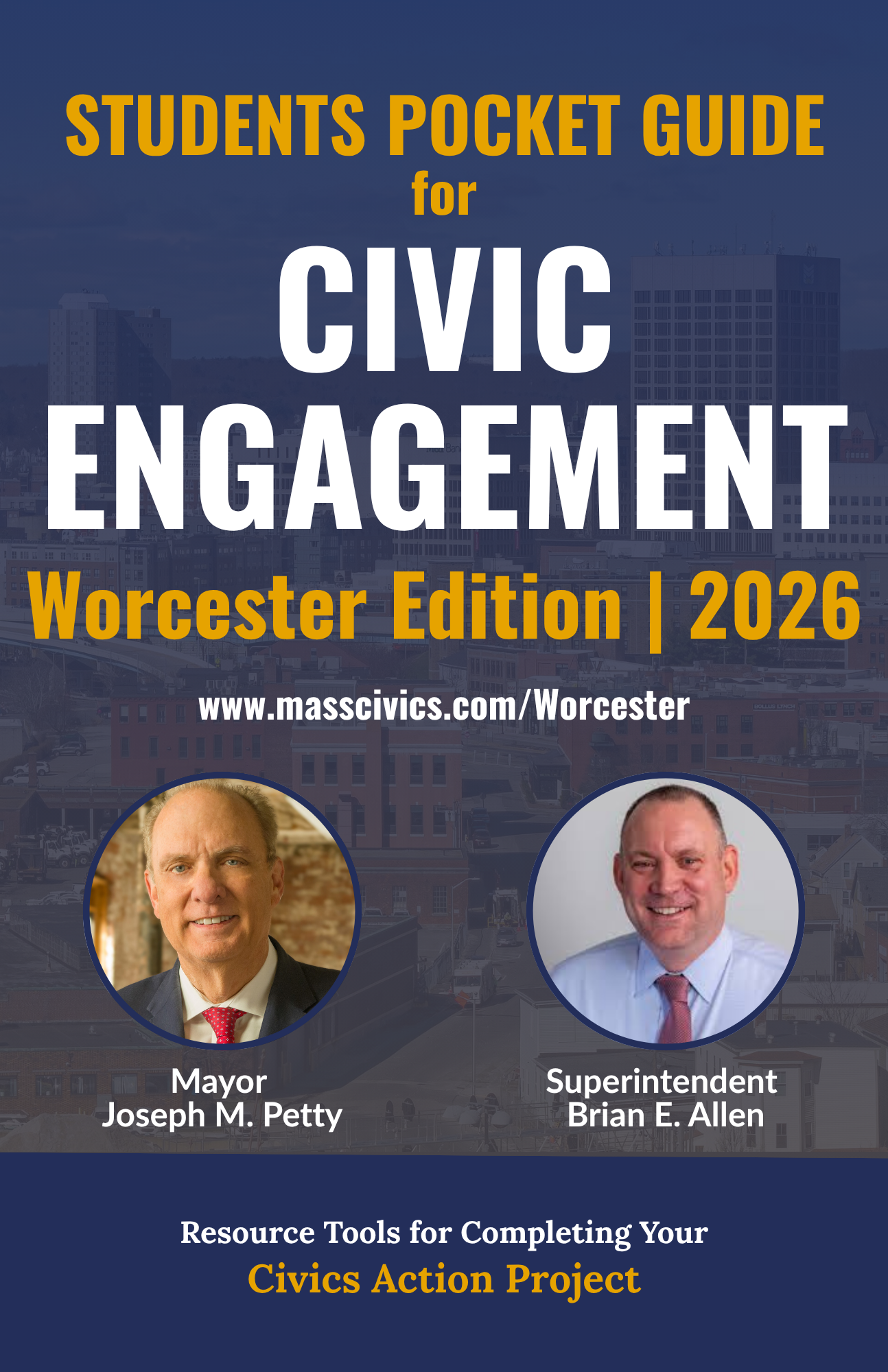
- Government: Plan E Council-Manager, City Manager Eric D. Batista (since 2022); Mayor Joseph M. Petty, popularly elected, chairs the City Council and School Committee.
- Schools: Worcester Public Schools, about 24,800 students across 47 schools, led by Superintendent Brian Allen.
How Worcester’s Government Works
Worcester runs on a system called “Plan E,” a council-manager charter the city adopted in 1947 and reshaped into its current form in 1985. Here is the short version. You and your neighbors elect a Mayor, an eleven-member City Council, and a School Committee. The Council then hires a professional City Manager to actually run the place day to day. Picture a company: the Council is the board of directors, the Mayor chairs that board, and the City Manager is the chief executive who carries out what the board decides.
City Manager
The chief executive, appointed by and accountable to the Council. Runs all departments, prepares the budget, and carries out Council policy.
City Council
The eleven-member legislative body, six at-large and five by district, sets policy, passes ordinances, and adopts the budget.
Mayor & School Committee
The Mayor, elected city-wide, is the city’s official head and chairs both the Council and the elected School Committee.
- You vote. Every two years, in odd-numbered years, Worcester elects the Mayor, all eleven councilors, and the School Committee.
- The Council hires the manager. Those councilors appoint a City Manager to administer the city and answer to them.
- The Mayor presides. Chosen directly by voters, the Mayor chairs both the Council and the School Committee.
- You keep pushing. Speaking at public comment, serving on a board, and calling your district councilor all shape what happens between elections.
Explore the Worcester Edition
- City LeadershipThe City Manager and the Mayor
- City CouncilYour eleven councilors
- School CommitteeSuperintendent & committee
- City DepartmentsWho does what at City Hall
- Boards & CommissionsWhere residents serve
- LegislatorsYour voice in Boston & D.C.
- Worcester HistoryHeart of the Commonwealth
- DemographicsWho lives in Worcester
- Non-ProfitsCommunity organizations
- Student DataWorcester Public Schools by the numbers
Civic Calendar
- City Council: meets most Tuesday evenings at City Hall, 455 Main Street.
- School Committee: meets twice monthly; broadcast on Worcester’s government channel and streamed online.
- Municipal elections: odd-numbered years (next November 2027); Mayor, all Council, and School Committee seats.
- State & federal elections: even-numbered years, the 2026 primary (Sept. 1) and general (Nov. 3) are this fall.
Your County Officials
Two of the people with the most direct power over your life are elected, and neither one sits on Beacon Hill. The district attorney decides who gets charged with a crime, and what they get charged with. The sheriff runs the county jail. The sheriff is elected by the voters of Worcester County. The district attorney is elected by the voters of a prosecution district, and Massachusetts draws eleven of those across its fourteen counties, so a district attorney’s territory does not always follow a county line. Both appear on your ballot in Worcester. Now you know what to look for.

Massachusetts elects fourteen sheriffs, one for each county, and eleven district attorneys, one for each prosecution district. The job is the same everywhere: the charging decisions, the jail. Look up any town in the state and see who holds these two offices there.
Your First Civic Action in Worcester
You do not have to wait until you can vote to be heard at City Hall. Here is a concrete way to start.
- Find your district. Worcester is split into five council districts, and your district councilor is the person whose job is to answer for your street: Tony Economou (District 1), Robert Bilotta (District 2), John Fresolo (District 3), Luis Ojeda (District 4), or Jose Rivera (District 5).
- Show up or write in. The Council meets most Tuesday evenings at City Hall, 455 Main Street. Residents can speak on agenda items, and any resident can file a petition asking the city to act, as long as it is in by 4:15 p.m. the Thursday before the meeting.
- Use the school lever too. The School Committee, which controls your school’s budget and policies, meets twice a month and takes public comment. For a Worcester teenager, this is the closest seat of power to your daily life.
- Watch a real fight play out. After a 2024 federal review of the Worcester Police Department, residents packed council meetings demanding a civilian review board, and the City Manager commissioned an independent study of how one might work. That argument is still live, and it is exactly the kind of decision public pressure can move.
Local government works best when residents show up. Find your district councilor, speak at a meeting, or apply to serve on a board.
Sources
This guide draws on public sources, refreshed July 2026: U.S. Census Bureau, Massachusetts DESE School and District Profiles, Massachusetts Legislature (malegislature.gov), and the official Worcester government website.