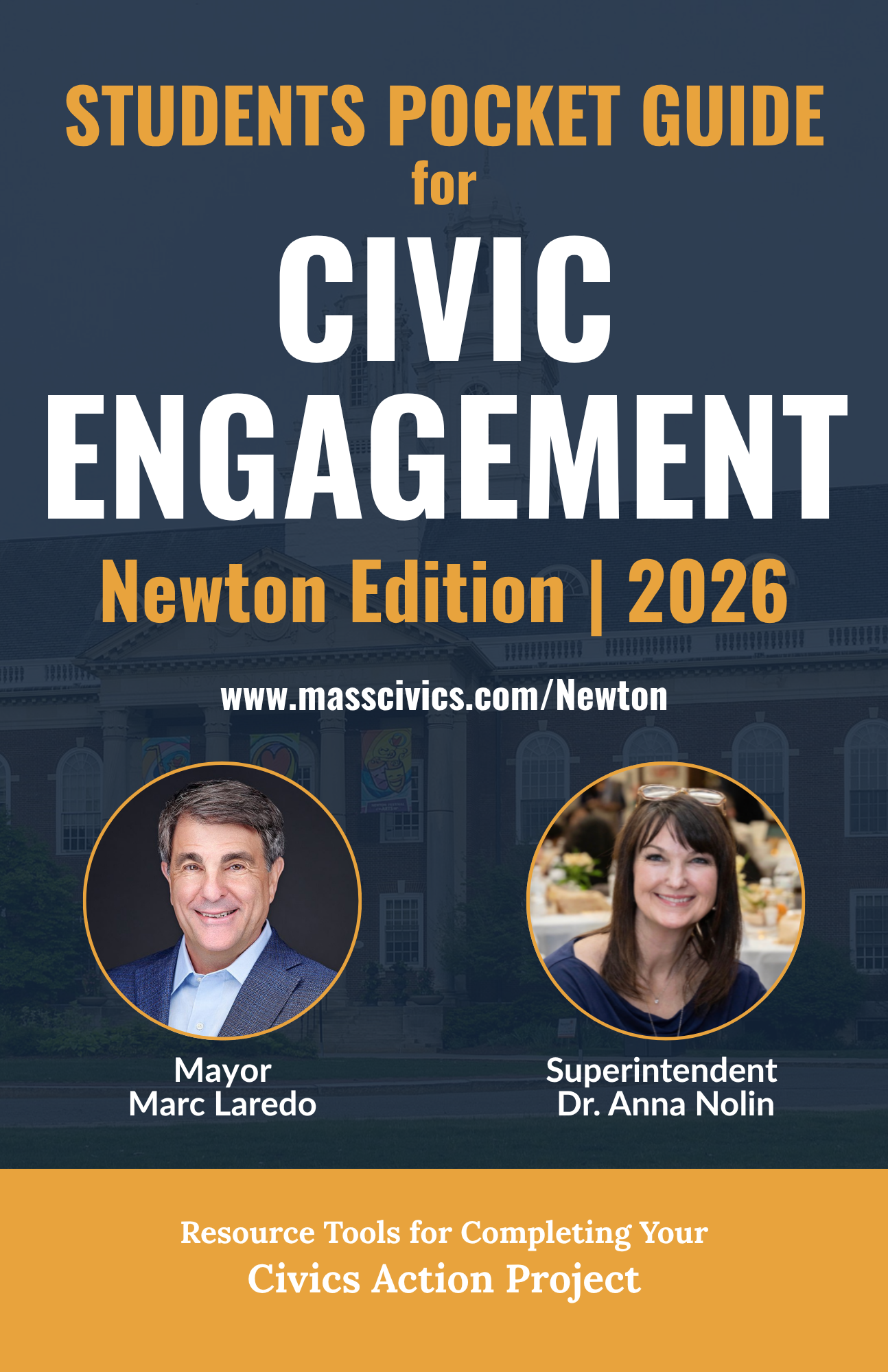

City Edition
Middlesex County
Newton, Massachusetts
Everything you need to understand and take part in local government in Newton: the mayor who runs the city, the twenty-four councilors who make its laws, the school committee that steers your classrooms, the legislators who carry your voice to Boston and Washington, and the data that tells Newton’s story. People call Newton the Garden City, but it is really thirteen villages stitched into one city of nearly ninety thousand people, and all of it answers to a government you can reach.

The Newton Civics Handbook
A plain-language guide to how your city works: who represents you, how decisions get made, and how to make your voice heard. Read it online.
Newton at a Glance
Sources: Massachusetts DESE, district profile · US Census Bureau (data.census.gov).
- County: Middlesex. Newton sits just west of Boston along the Charles River, a city of thirteen distinct villages.
- Government: Strong-mayor city government. Mayor Marc Laredo took office on January 1, 2026, and a twenty-four-member City Council makes the city’s laws.
- Schools: Newton Public Schools, about 11,500 students across 21 schools, led by Superintendent Anna Nolin.
How Newton’s Government Works
Newton runs on a strong-mayor charter. Voters elect a Mayor to a four-year term as the city’s chief executive, a twenty-four-member City Council to two-year terms as the lawmaking body, and a School Committee to govern the public schools. Power is split on purpose, so no single office decides everything alone.
Mayor
The chief executive, elected by the whole city. Proposes the budget, runs every department, makes appointments, and carries out the law.
City Council
The twenty-four-member lawmaking body: eight Ward Councilors and sixteen Councilors-at-Large. It passes ordinances and adopts the budget.
School Committee
The elected board that hires the superintendent, adopts the school budget, and sets policy for Newton Public Schools.
- Residents elect the Mayor, the twenty-four councilors, and the School Committee.
- The Mayor proposes a budget and runs the city day to day.
- The Council votes the budget, the ordinances, and the appointments up or down.
- You take part by speaking at meetings, serving on a board, and contacting your ward councilor.
Explore the Newton Edition
- Mayor’s OfficeThe city’s chief executive
- City CouncilYour twenty-four councilors
- School CommitteeSuperintendent & committee
- City DepartmentsWho does what at City Hall
- Boards & CommissionsWhere residents serve
- LegislatorsYour voice in Boston & D.C.
- Newton HistoryFrom farm town to Garden City
- DemographicsWho lives in Newton
- Non-ProfitsCommunity organizations
- Student DataNewton Public Schools by the numbers
Civic Calendar
- City Council: meets the first and third Monday of each month in the Council Chamber at City Hall, 1000 Commonwealth Avenue.
- School Committee: meets twice monthly. Agendas are posted in advance and meetings are broadcast.
- Municipal elections: odd-numbered years (next November 2027). All Council and School Committee seats are on the ballot.
- State and federal elections: even-numbered years. The 2026 primary and general are this fall.
Your County Officials
Two of the people with the most direct power over your life are elected countywide. The district attorney decides who gets charged with a crime, and what they get charged with. The sheriff runs the county jail. Both of them answer to the voters of Middlesex County, and that includes Newton. They appear on your ballot. Now you know what to look for.


Every county in Massachusetts elects its own, and the job is the same everywhere: the charging decisions, the jail. Look up any town in the state and see who holds these two offices there.
Your First Civic Action in Newton
You do not have to wait until you can vote to be heard. Here is a concrete path from “I care about this” to “I said it on the record to the people who decide,” using rooms and phone numbers that are already open to you.
- Pick the right body. A park, a road, a pothole, taxes, or a line in the city budget is City Council territory. Your school, a class, a program, or the school calendar belongs to the School Committee.
- Find the meeting. The City Council meets on the first and third Monday of each month in the Council Chamber at City Hall, 1000 Commonwealth Avenue. The School Committee meets twice a month. Agendas post in advance through the City Clerk’s office at newtonma.gov.
- Know your councillors. Newton has twenty-four councilors. Eight are ward councilors, one tied to your own ward, and sixteen are councilors-at-large, two for each ward but elected by the whole city. The City Clerk and Elections office, which staffs the Council and its agenda, is your way in at 617-796-1200.
- Speak. Both the Council and the School Committee open their meetings to public comment. You sign up, you get your minutes, and you say your piece on the record.
- Or skip the trip. Report a pothole, a broken streetlight, or a trash problem any time through Newton 311 at newtonma.gov, or call City Hall at 617-796-1000.
- City Hall (main line): 617-796-1000
- City Clerk and Council agendas: 617-796-1200, newtonma.gov
- Newton Public Schools: 617-559-6000, newton.k12.ma.us
Local government works best when residents show up. Find your ward councilor, speak at a meeting, or apply to serve on a board.
Sources
This guide draws on public sources, refreshed July 2026: U.S. Census Bureau, Massachusetts DESE School and District Profiles, Massachusetts Legislature (malegislature.gov), and the official Newton government website.