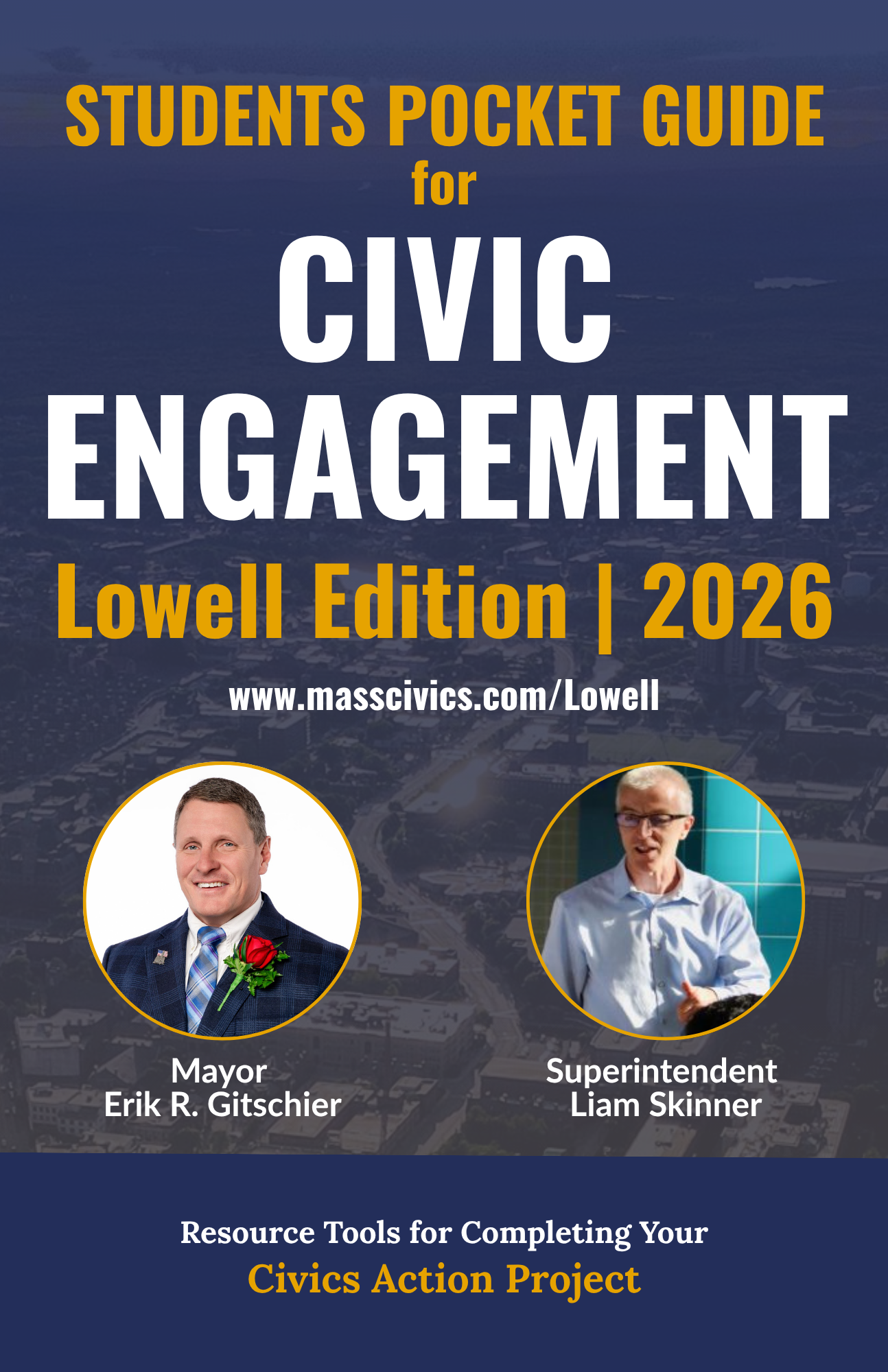
Your civics project
How to actually change something in Lowell
Massachusetts law says you have to do a civics project. It does not say it has to be pretend. Every lever on this page is real, it is written into state law, and it works in Lowell specifically.
The law is Chapter 71, Section 2 of the General Laws: every public school serving eighth graders, and every public high school, must provide “not less than 1 student-led, non-partisan civics project for each student.” That is the assignment. What follows is how to make it land somewhere real.
Step one
Find the body that actually decides your issue.
This is where most projects go wrong. Students take a real problem to the wrong room, get a polite nothing, and conclude that nobody listens. The truth is duller and more useful: they were talking to people who did not have the power to say yes.
- Your school building, your classes, your school’s rules and budget: the School Committee. They hire the superintendent and adopt the school budget. They do not run the police or the roads.
- Streets, sidewalks, parks, local police and fire, the local budget: the legislative body of Lowell, working with its executive. The Lowell guide names both.
- State law, and anything about the age you can do something at: your State Representative and State Senator, not anyone in local government.
Match the issue to the body first. The rest of the project gets three times easier.
The lever
Your council has to hear it in public.
Lowell is run by a council, not a town meeting. That means the route is different from most of Massachusetts: instead of putting an article on a warrant, you bring your issue to the councillors who represent you, and to the committee that handles it.
Councils do their real work in committee, in public, and they take public comment. A councillor who hears the same specific, well researched ask from a real constituent three times will usually ask staff about it, and that is how most things actually start.
Find the Clerk’s number on Lowell’s official website and call it. We do not print a number here that we cannot verify, because a wrong one wastes your afternoon. Ask two questions: which committee handles this issue, and how a resident signs up to speak at its next meeting. The Clerk’s office answers this every day. Asking it is itself the civic skill.
What to bring
Ask for one specific thing.
“Do something about the buses” is not an ask. “Move the 7:10 stop on Washington Street two hundred feet north so it is not on a blind curve” is an ask. A specific request can be said yes to. A general complaint can only be agreed with, which is not the same thing and does not change anything.
Bring three things: the specific ask, who it affects and how many of them, and what it would take to do it. If you do not know what it would take, say so and ask. Officials are far more willing to help someone who has clearly done the reading.
Every ask lands somewhere specific, and there is a template for each one: a board, a records request, your legislator, your local paper.
Who to ask
The Clerk is the most useful phone call in local government.
The Clerk’s office knows when every body meets, what the deadlines are, and how a resident gets on an agenda. They will tell you. It is literally their job.
We deliberately do not print meeting times or agendas on this page. They change, and a page that sends you to a locked building on the wrong Tuesday has taught you the wrong lesson about civics. Call and ask. The answer you get on the phone is current; the one on a webpage might not be.