
City Edition
Middlesex County
Watertown, Massachusetts
The falls on the Charles River that cut through the middle of your city are the reason Watertown exists. The Massachusett people trapped herring there for generations, English colonists built one of the first inland towns of the Bay Colony around them in 1630, and the U.S. Army later ran a sprawling weapons arsenal a few hundred yards downstream. Today Watertown is a small, dense, fast-changing city of about 35,000 people that, by a quirk of history, is still legally called the Town of Watertown. This guide shows you how it works today: the City Manager who runs it, the Council you elect, the legislators who carry your voice to Boston and Washington, and the data behind it all.

The Watertown Civics Handbook
A plain-language guide to how your city works: who represents you, how decisions get made, and how to make your voice heard. Read it online.
Watertown at a Glance
Sources: Massachusetts DESE, district profile · US Census Bureau (data.census.gov).
- County: Middlesex. Watertown sits on the Charles River just west of Boston, packed into about four square miles, which makes it one of the most densely settled communities in the state.
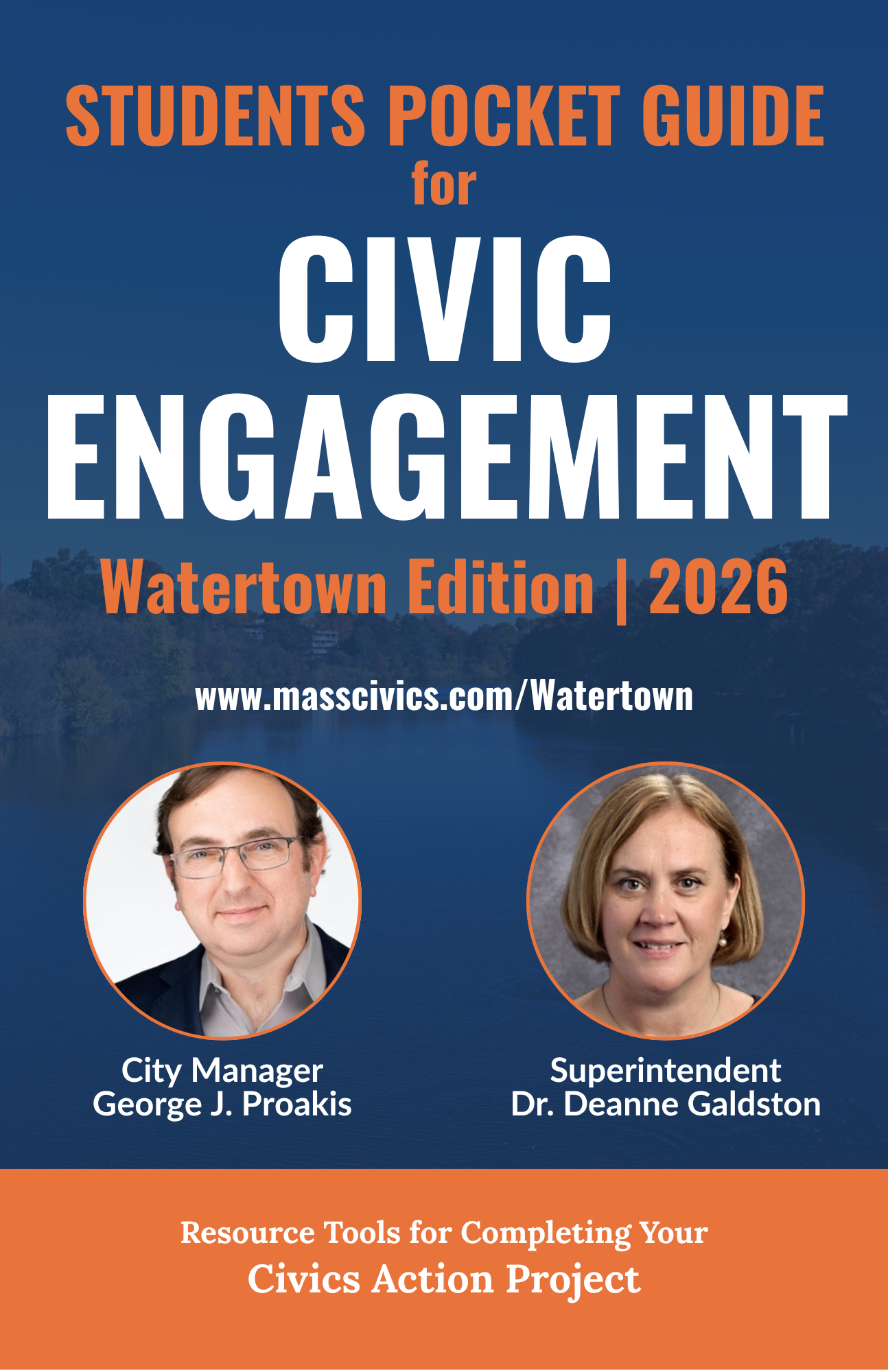
- Government: council-manager city. An appointed City Manager, George J. Proakis, runs the city day to day, hired by the elected City Council. There is no mayor.
- Schools: Watertown Public Schools, about 2,843 students across five schools, led by Superintendent Dr. Deanne (Dede) Galdston.
How Watertown’s Government Works
Watertown is legally a city, still called the Town of Watertown out of long habit, and it runs on a council-manager charter that took full effect in 2021. Voters do not elect a mayor. Instead they elect a nine-member City Council and a School Committee, and the Council hires a professional City Manager to run the city. So the levers are split on purpose: residents elect the Council, the Council sets policy and hires the Manager, and the Manager carries it out and runs the departments.
City Manager
The appointed chief executive. Runs every department, appoints most department heads, builds the budget, and answers to the City Council. Hired under contract, not elected.
City Council
The nine-member legislative body. A Council President and four at-large members are elected citywide, and four councillors represent Districts A through D. The Council sets policy, passes ordinances, and adopts the budget.
School Committee
Six members elected citywide, plus the Council President as an ex officio seat. It sets school policy, approves the school budget, and hires the Superintendent.
- Residents elect the nine councillors and the School Committee.
- The Council hires the City Manager and sets city policy.
- The City Manager runs the city day to day and proposes the budget.
- You take part: public comment, board service, and a call to your district councillor all shape what happens next.
Explore the Watertown Edition
- City Manager’s OfficeThe city’s chief executive
- City CouncilYour nine councillors
- School CommitteeSuperintendent & committee
- City DepartmentsWho does what at City Hall
- Boards & CommissionsWhere residents serve
- LegislatorsYour voice in Boston & D.C.
- Watertown HistoryFrom a fishing weir to a city of firsts
- DemographicsWho lives in Watertown
- Non-ProfitsCommunity organizations
- Student DataWatertown Public Schools by the numbers
Civic Calendar
- City Council: meets the second and fourth Tuesday of most months at 7 PM in the Richard E. Mastrangelo Council Chamber, City Hall, 149 Main Street.
- School Committee: meets at the Watertown Public Schools administration building, and agendas are posted on the district website.
- Municipal elections: odd-numbered years. The Council and School Committee were last chosen in November 2025. The next city election is in 2027.
- State and federal elections: even-numbered years. The 2026 primary and general are this fall.
Your County Officials
Two of the people with the most direct power over your life are elected countywide. The district attorney decides who gets charged with a crime, and what they get charged with. The sheriff runs the county jail. Both of them answer to the voters of Middlesex County, and that includes Watertown. They appear on your ballot. Now you know what to look for.


Every county in Massachusetts elects its own, and the job is the same everywhere: the charging decisions, the jail. Look up any town in the state and see who holds these two offices there.
Your First Civic Action in Watertown
You do not have to be old enough to vote to change something in your city. Here is how to actually do it.
- Pick the right body. Streets, parks, the budget, and most local policy run through the City Council. Anything about the schools goes to the School Committee.
- Find the meeting. The City Council meets the second and fourth Tuesday of most months at 7 PM in the Richard E. Mastrangelo Council Chamber at City Hall, 149 Main Street.
- Know your councillors. You have a Council President and four at-large members elected by the whole city, plus a district councillor for your part of town. Find yours on the City Council page.
- Speak. Public comment is built into the agenda, and you do not have to be a registered voter to take the microphone.
- Or skip the trip. Report a pothole, a missed pickup, or a broken streetlight any time through Watertown’s 311 Service Center online.
- City Hall: 149 Main Street, Watertown, MA 02472. Main line 617-972-6486.
- Council & agendas: City Council office 617-972-6470, citycouncilors@watertown-ma.gov. Agendas are posted in advance on the city’s online meeting portal.
- Public schools: Watertown Public Schools, 617-926-7700, watertown.k12.ma.us.
Local government works best when residents show up. Find your district councillor, speak at a Tuesday meeting, or apply to serve on a board.
Sources
This guide draws on public sources, refreshed July 2026: U.S. Census Bureau, Massachusetts DESE School and District Profiles, Massachusetts Legislature (malegislature.gov), and the official Watertown government website.