
City Edition
Middlesex County
Marlborough, Massachusetts
A century ago Marlborough made boots for the whole country. Today the headquarters of Boston Scientific, Hologic, and BJ’s Wholesale Club rise along the highways at the edge of town, and the people who decide how this city of about 41,000 actually runs still meet on Monday nights in a chamber on Main Street that you can walk into. This guide shows you how Marlborough works today: the mayor who runs it, the eleven councilors who make its laws, the legislators who carry your voice to Boston and Washington, and the data behind it all.

The Marlborough Civics Handbook
A plain-language guide to how your city works: who represents you, how decisions get made, and how to make your voice heard. Read it online.
Marlborough at a Glance
Sources: Massachusetts DESE, district profile · US Census Bureau (data.census.gov).
- County: Middlesex. Marlborough sits where Interstates 495 and 290 meet Route 20, about 30 miles west of Boston, in the heart of the MetroWest region.
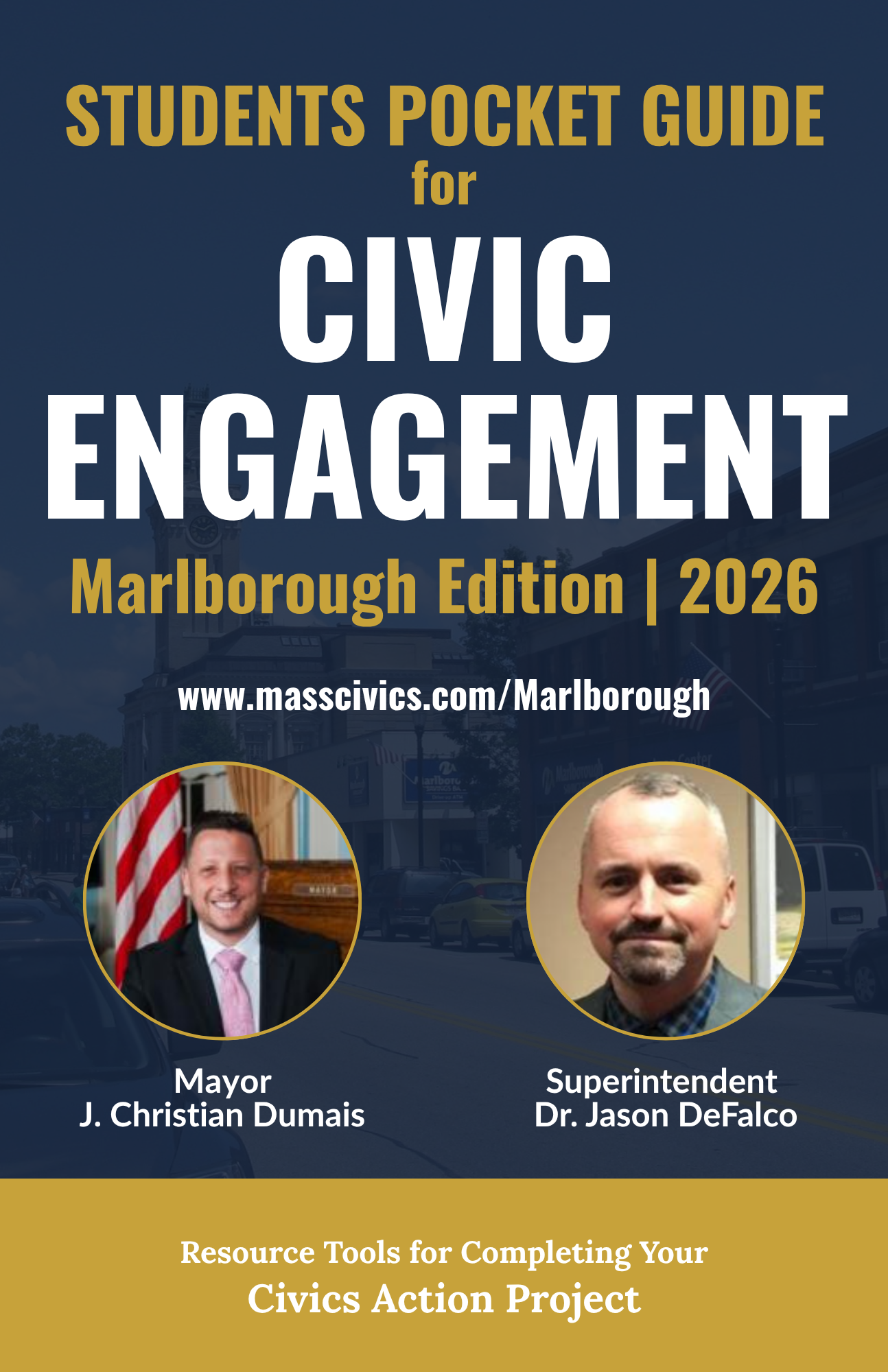
- Government: Plan A strong-mayor charter. Mayor J. Christian Dumais has led the city since January 2024.
- Schools: Marlborough Public Schools, about 4,360 students across seven schools, led by Superintendent Dr. Jason DeFalco.
How Marlborough’s Government Works
Marlborough runs on a strong-mayor charter, known as Plan A. Voters elect a Mayor to run the city and an eleven-member City Council to make its laws, and they elect a School Committee to oversee the schools. The Mayor holds real executive power: appointing department heads, proposing the budget, and signing or vetoing what the Council passes.
The Mayor
The elected chief executive. Runs every department, appoints department heads and most board members, proposes the budget, and can veto Council orders.
City Council
The eleven-member legislative body. Seven councilors are elected by ward and four at large. The Council passes ordinances, sets the tax rate, and adopts the budget.
School Committee
Seven members elected by voters, chaired by the Mayor. It sets school policy, approves the school budget, and hires the Superintendent.
- Residents elect the Mayor, the eleven councilors, and the School Committee.
- The Mayor runs the city day to day and proposes the budget.
- The Council votes the budget and the ordinances up or down, and can override a veto.
- You take part: public comment, board service, and a call to your ward councilor all shape what happens next.
Explore the Marlborough Edition
- Mayor’s OfficeThe city’s chief executive
- City CouncilYour eleven councilors
- School CommitteeSuperintendent & committee
- City DepartmentsWho does what at City Hall
- Boards & CommissionsWhere residents serve
- LegislatorsYour voice in Boston & D.C.
- Marlborough HistoryFrom a praying town to headquarters country
- DemographicsWho lives in Marlborough
- Non-ProfitsCommunity organizations
- Student DataMarlborough Public Schools by the numbers
Civic Calendar
- City Council: meets on Monday evenings at 8:00 PM in the Council Chambers, second floor of City Hall, 140 Main Street.
- School Committee: meets at the district administration offices, with agendas posted on the district website.
- Municipal elections: odd-numbered years. The Mayor, Council, and School Committee were last chosen in November 2025. They next run in 2027.
- State and federal elections: even-numbered years. The 2026 primary and general are this fall.
Your County Officials
Two of the people with the most direct power over your life are elected countywide. The district attorney decides who gets charged with a crime, and what they get charged with. The sheriff runs the county jail. Both of them answer to the voters of Middlesex County, and that includes Marlborough. They appear on your ballot. Now you know what to look for.


Every county in Massachusetts elects its own, and the job is the same everywhere: the charging decisions, the jail. Look up any town in the state and see who holds these two offices there.
Your First Civic Action in Marlborough
The fastest way to feel how the city works is to bring one real concern to the people who can fix it. Here is how to do it from scratch.
- Pick the right body. Streets, the budget, and ordinances go to the City Council. Anything about the schools goes to the School Committee.
- Find the meeting. The Council meets Monday evenings at 8:00 PM in the Council Chambers on the second floor of City Hall, 140 Main Street.
- Know your councilors. You have four at-large councilors who answer to the whole city, plus one councilor for your own ward. Find your ward on the city website.
- Speak. Residents can address the Council. Check the agenda at the city’s online Agenda Center for the public-comment procedure.
- Or skip the trip. Report a pothole, a dead streetlight, or a missed pickup any time through Marlborough’s online SeeClickFix tool.
- City Hall: 140 Main Street, Marlborough, MA 01752. City Council office 508-460-3711.
- Agendas & minutes: City Clerk Steven W. Kerrigan, cityclerk@marlborough-ma.gov, with agendas posted at the city’s online Agenda Center.
- Public schools: Marlborough Public Schools, 508-460-3500, mps-edu.org.
Local government works best when residents show up. Find your ward councilor, speak at a Monday meeting, or apply to serve on a board.
Sources
This guide draws on public sources, refreshed July 2026: U.S. Census Bureau, Massachusetts DESE School and District Profiles, Massachusetts Legislature (malegislature.gov), and the official Marlborough government website.